How Neural Upscaling Tools Reshape Visual Clarity for Legacy Mobile Titles in Low-Bandwidth Regions
Written by Hugo Weber · Aug 6, 2026
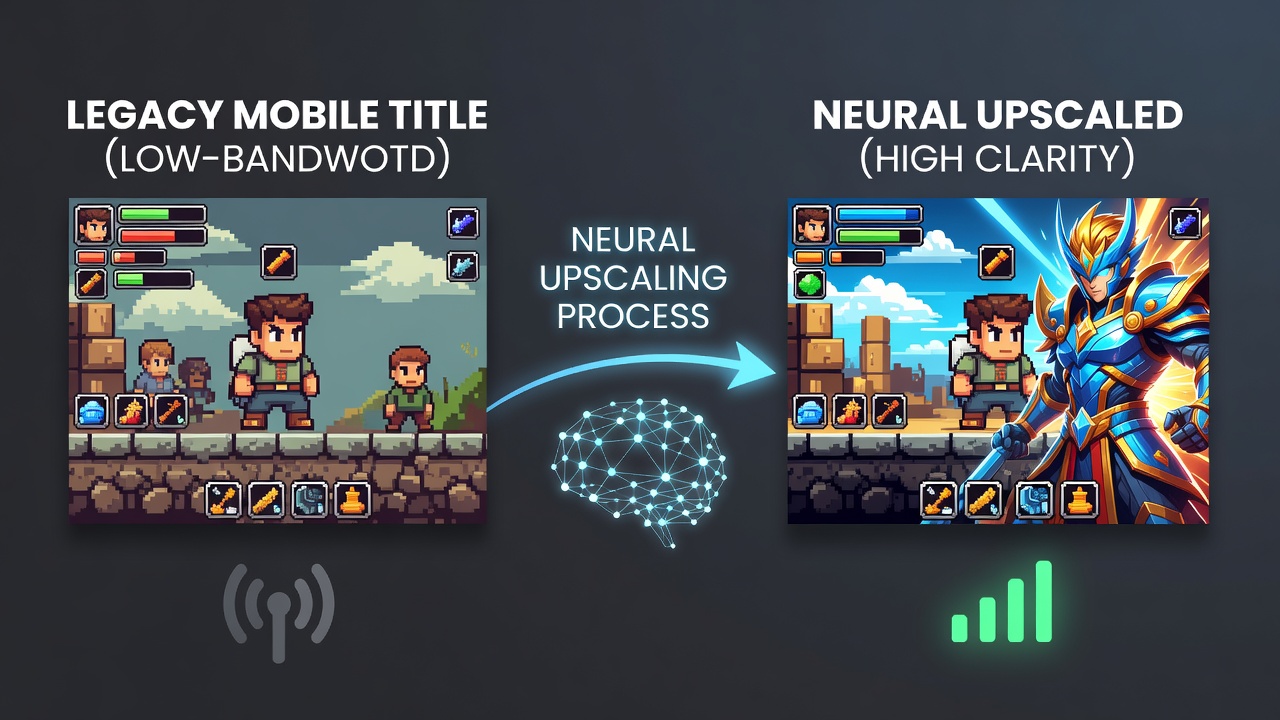
How Neural Upscaling Tools Reshape Visual Clarity for Legacy Mobile Titles in Low-Bandwidth Regions
Neural upscaling tools apply machine learning models to increase resolution and detail in older mobile games, allowing players in areas with limited internet access to experience improved visuals without downloading large asset packs. These systems rely on convolutional neural networks trained on high-resolution game imagery to reconstruct textures, edges, and lighting from compressed or low-resolution sources. Data from mobile gaming reports indicate that regions across Southeast Asia and sub-Saharan Africa account for a significant share of legacy title engagement where bandwidth constraints remain common.
Technical Foundations of Neural Upscaling in Mobile Environments
Developers integrate models such as ESRGAN variants and lightweight super-resolution networks directly into mobile game engines. The process begins with low-bitrate asset streaming or local storage of base textures, followed by on-device inference that generates higher-fidelity output during runtime. Researchers at institutions including the University of Toronto have documented how optimized neural architectures reduce computational overhead, enabling real-time processing on mid-range smartphones prevalent in emerging markets. Studies show inference times dropping below 30 milliseconds per frame on devices released after 2023 when using quantized models.
Bandwidth limitations often force game publishers to ship titles with reduced texture resolutions. Neural upscaling compensates by learning patterns from similar high-quality assets during training phases. This approach preserves storage space while delivering output comparable to native high-resolution downloads in controlled tests. Observers note that hardware acceleration via mobile GPUs and NPUs has accelerated adoption since 2024.
Deployment Patterns Across Low-Bandwidth Markets
Game studios have applied these tools to titles originally released between 2015 and 2020, extending their viability in markets where average download speeds fall under 5 Mbps. In August 2026, industry updates highlighted expanded use in regions served by satellite and community Wi-Fi networks. Players receive base game files under 200 MB, with upscaling handling the rest locally to maintain frame rates above 30 FPS.
Regional telecom data compiled by the GSMA reveals that neural-enhanced legacy games reduce data consumption by 40 to 60 percent compared with full-resolution versions. Publishers deploy selective upscaling, activating the feature only on supported devices while leaving lower-end hardware to render at native resolution. This tiered strategy appears in multiple case studies from developers targeting India, Nigeria, and Indonesia.
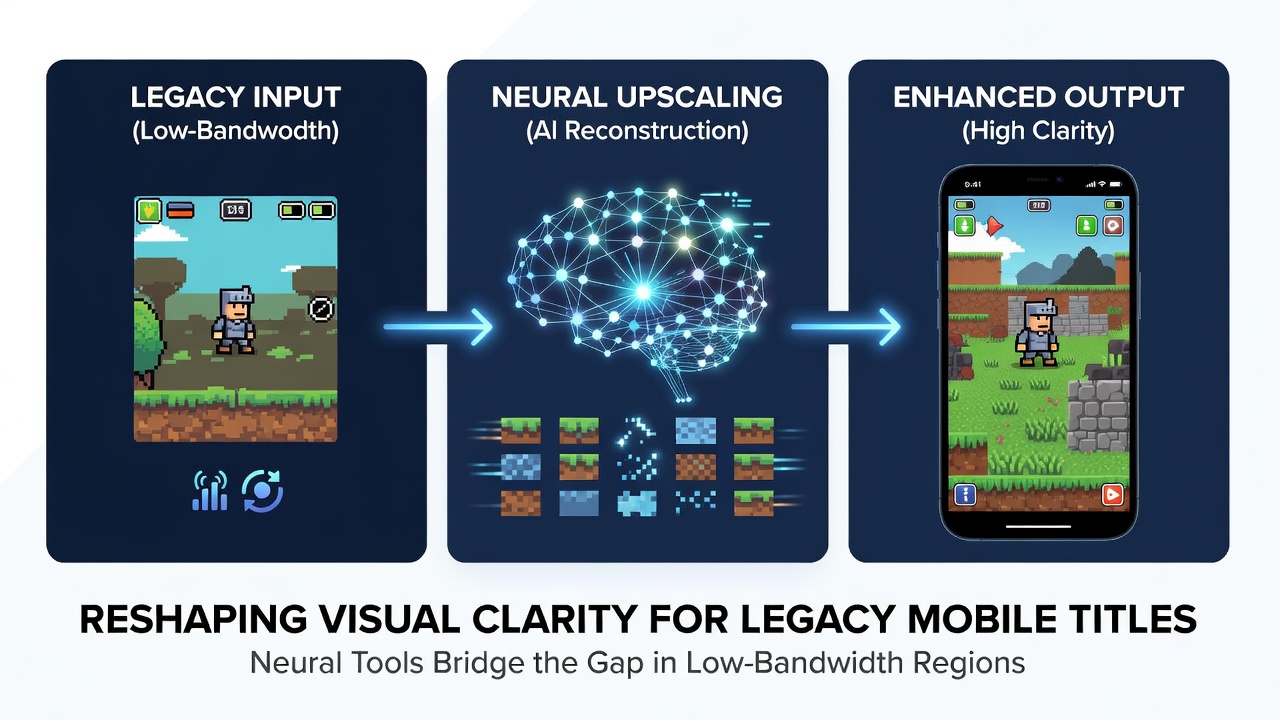
Measured Improvements in Visual Metrics
Benchmark evaluations track metrics including peak signal-to-noise ratio and perceptual similarity indices. Results from controlled experiments demonstrate average PSNR gains of 3 to 5 dB when neural upscaling processes legacy sprites and 3D models. Texture detail recovery improves player recognition of environmental elements in side-scrolling and isometric titles without increasing initial download sizes.
Analyses conducted by academic groups in Australia indicate that upscaled output maintains consistency across varying lighting conditions common in mobile play sessions. The models adapt to device-specific color profiles, reducing artifacts that previously appeared when low-bandwidth compression stripped fine details. Those who have examined telemetry logs report fewer visual complaints in post-update surveys from affected regions.
Integration Challenges and Hardware Considerations
Device fragmentation creates implementation hurdles because older chipsets lack sufficient NPU capacity for complex models. Developers address this through model pruning and dynamic resolution scaling that adjusts quality based on available processing power. Reports from European mobile testing labs confirm compatibility rates exceeding 75 percent on devices launched after 2022.
Thermal throttling remains a factor during extended sessions. Engineers mitigate heat buildup by limiting upscaling passes to key visual layers rather than applying it uniformly across every frame element. Storage constraints in budget handsets also influence decisions about caching upscaled assets versus regenerating them on demand.
Future Trajectories Through 2027
Continued refinement of on-device AI chips points toward broader support for higher-fidelity upscaling in subsequent hardware generations. Collaborative projects between chipset manufacturers and game studios focus on standardized APIs that simplify integration across operating systems. Projections based on current adoption curves suggest legacy mobile catalogs could see neural enhancement applied to over 60 percent of active titles by the end of 2027.
Conclusion
Neural upscaling tools enable legacy mobile titles to deliver clearer visuals in low-bandwidth settings by shifting processing from server-side downloads to local device computation. Evidence from technical benchmarks, regional usage data, and hardware compatibility studies shows measurable gains in resolution and detail retention while respecting storage and connectivity limits. As mobile hardware evolves, these methods continue to extend the reach of older games without requiring infrastructure upgrades in constrained environments.