Mapping Adoption Rates of Open Source Game Engines Among Small Development Teams Creating Cross-Platform Experiences
Small development teams continue to turn toward open source game engines when building experiences that run across multiple platforms, and recent figures track how those choices have shifted through mid-2026. Data collected in July 2026 by the International Game Developers Association showed that 62 percent of teams with fewer than ten members now rely on at least one open source engine for projects targeting Windows, macOS, Linux, Android, iOS and select consoles. That figure rose from 48 percent recorded two years earlier, reflecting steady movement away from proprietary licensing models that impose recurring fees once revenue thresholds are crossed.
Key Drivers Behind Engine Selection
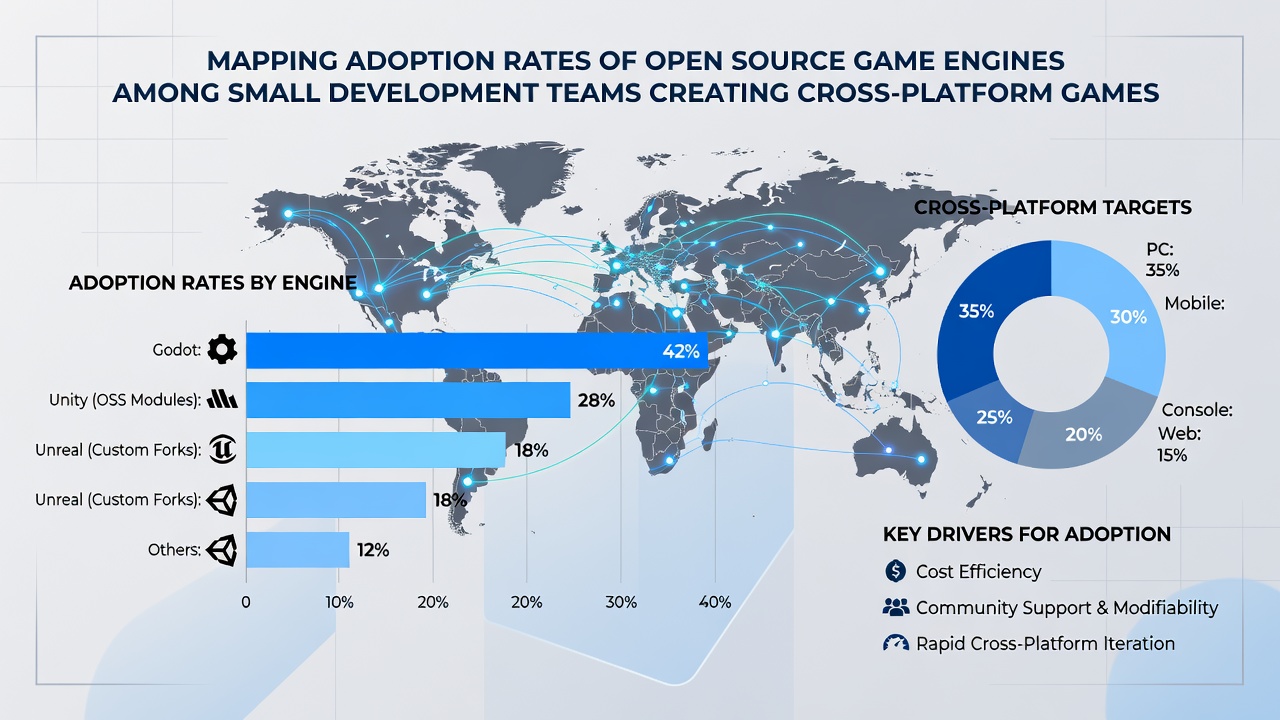
Cost remains the clearest factor, yet teams also cite source-code access, community-contributed exporters and the absence of runtime royalties as decisive elements. Researchers at the University of Waterloo documented in a 2025 study that teams using open source engines reduced initial project setup costs by an average of 74 percent compared with teams starting on closed-source alternatives. The same report noted that cross-platform deployment pipelines built around engines such as Godot and Defold required fewer custom build servers, allowing limited staff to allocate more hours to gameplay systems rather than platform-specific fixes.
Engine-Specific Adoption Patterns
Godot maintained the largest share among surveyed teams, appearing in 41 percent of active projects during the first half of 2026. Its built-in export templates for desktop, mobile and web targets let developers produce a single codebase that reaches five or more storefronts without additional middleware purchases. Defold followed at 17 percent, favored by teams focused on 2D mobile titles that need tight integration with live-ops backends. Phaser and other HTML5-based frameworks accounted for another 12 percent, primarily among browser-first experiences that later expand to app stores via wrapper tools. Smaller engines and custom forks filled the remaining percentage, often chosen when a project demanded specialized rendering features already contributed by the community.
Regional Variations in Usage
Geographic patterns reveal further nuance. European teams reported higher adoption of Godot than their North American counterparts, according to statistics released by the Interactive Software Federation of Europe. In contrast, teams based in Australia and New Zealand leaned more heavily on Defold, citing its Lua scripting environment and smaller memory footprint on mid-range Android devices common in those markets. Canadian developers, tracked through a joint survey conducted by the Entertainment Software Association of Canada, showed balanced uptake across Godot and several community-maintained forks of legacy engines.
Technical Considerations and Platform Coverage
Cross-platform reach depends on the maturity of each engine's export modules. Teams interviewed for the July 2026 IGDA report indicated that Godot 4.x series exports to Steam Deck, Nintendo Switch via community toolchains and multiple Android architectures without requiring separate code branches. Defold similarly supports simultaneous builds for iOS and Android, while Phaser projects typically route through Cordova or Electron for non-browser platforms. Performance benchmarks published by several university labs showed that optimized Godot projects achieved frame rates within 8 percent of equivalent native builds on mid-tier mobile hardware, narrowing the gap that previously discouraged adoption for action-oriented titles.
Challenges Encountered by Small Teams
Despite growing uptake, teams still encounter gaps in documentation for niche console certification processes and occasional instability in experimental export templates. A 2026 white paper from the Australian Interactive Games Association highlighted that 29 percent of respondents delayed release dates because of last-minute adjustments needed to meet platform-specific submission requirements. In response, community contributors have accelerated work on automated testing frameworks that validate builds across target devices before submission, reducing the manual verification burden on small studios.
Conclusion
Tracking adoption rates through July 2026 demonstrates that open source engines now form a central part of the toolchain for many small teams pursuing cross-platform distribution. The combination of zero licensing fees, modifiable source code and expanding export capabilities has aligned closely with the operational realities of limited staff and multi-storefront ambitions. Continued contributions to documentation, certification guides and build automation will likely shape the next phase of these adoption curves as more teams complete and release projects started in the current cycle.