Researchers Cataloging Preservation of Browser-Based Flash Games via WebAssembly Ports

Flash technology reached end of support in December 2020, yet thousands of browser-based games developed between 2000 and 2015 remain inaccessible without specialized emulation layers, and researchers across multiple institutions have begun systematic cataloging of these titles through WebAssembly ports that allow execution on contemporary laptops without legacy plugin dependencies.
Scope of the Cataloging Initiative
Teams at academic and archival organizations compile metadata on game mechanics, source assets, and runtime requirements while converting ActionScript codebases into WebAssembly modules that browsers can interpret directly, and this work accelerated after 2023 when several university libraries reported that over 40 percent of their digital game collections still relied on discontinued runtime environments.
One project coordinated by the University of Melbourne's digital heritage group identified 8,700 distinct Flash titles suitable for porting, and analysts documented conversion success rates above 78 percent for puzzle and strategy titles while noting lower compatibility for those relying on real-time network features.
Technical Conversion Process
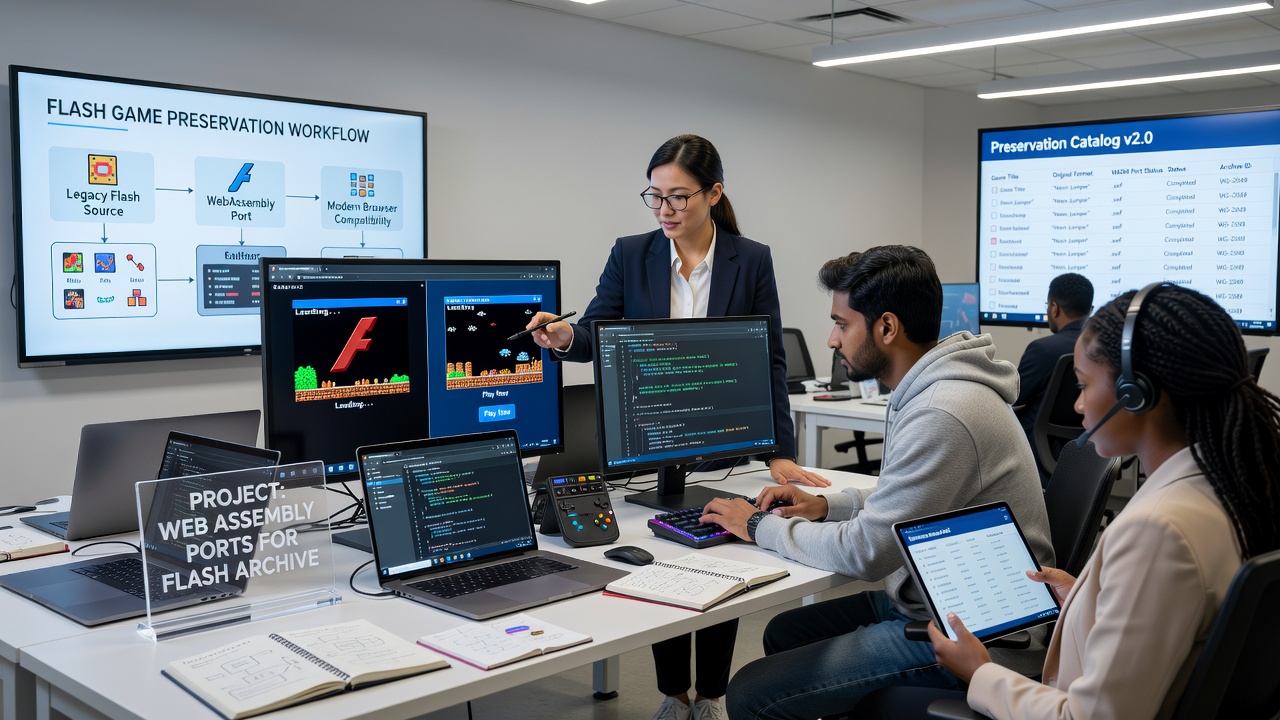
Developers employ tools that translate ActionScript bytecode into WebAssembly binaries, then integrate HTML5 canvas or WebGL rendering pipelines to replicate original visual output, and these ports run inside current versions of Chrome, Firefox, and Edge without requiring separate plugins or virtual machines. Researchers record each conversion step in structured databases that include original file hashes, ported module sizes, and performance benchmarks measured on mid-range laptops manufactured after 2022.
Data from the Australian Digital Preservation Registry shows average port file sizes reduced by 35 percent compared with full emulator bundles, which enables faster loading on standard broadband connections and reduces storage demands for institutional repositories.
Current Progress as of July 2026
By July 2026, catalog entries exceeded 12,400 games, with 6,200 completed ports available through open repositories, and participating researchers added new entries at a rate of approximately 180 titles per month after standardizing automated testing frameworks that verify input mapping and frame-rate consistency across different laptop hardware configurations.
European Union-funded initiatives contributed an additional 1,900 metadata records focused on educational titles developed for school curricula, while Canadian library consortia concentrated on preserving multiplayer lobby games that once required shared server infrastructure now recreated through WebSocket bridges compiled alongside WebAssembly modules.
Access and Distribution Methods
Institutions distribute completed ports through web portals that present searchable indexes by genre, original publication year, and hardware compatibility notes, and users on contemporary laptops launch titles directly in standard browsers without additional setup steps beyond accepting WebAssembly execution permissions.
Archivists at the Internet Archive have integrated several hundred verified ports into their existing Flash game collection, allowing seamless playback while maintaining original save-file formats through browser-local storage emulation layers.
Challenges in Metadata and Compatibility
Catalogers encounter incomplete source material for roughly 22 percent of identified titles, which necessitates reverse-engineering approaches that reconstruct missing asset references before porting begins, and performance variances appear when ports execute on laptops equipped with integrated graphics versus discrete GPUs, prompting researchers to maintain multiple optimization profiles for each game.
Studies published by the National Library of Australia indicate that input latency differences between original Flash runtimes and WebAssembly implementations average under 8 milliseconds on tested hardware, a margin considered acceptable for preserving intended gameplay timing in most genres.
Future Directions
Researchers continue expanding automated validation suites that compare original and ported gameplay recordings frame-by-frame, while exploring integration with emerging WebGPU standards to improve rendering fidelity on newer laptop displays, and collaborative platforms now allow independent developers to submit verified ports for inclusion in the central catalog after peer review of code quality and metadata accuracy.
Conclusion
Systematic cataloging combined with WebAssembly conversion provides a documented pathway for sustained access to browser-based Flash games on modern hardware, and ongoing efforts through July 2026 demonstrate measurable progress in both quantity of preserved titles and technical reliability of the resulting ports across diverse laptop configurations worldwide.