Shadow Mapping Evolutions in Atmospheric Adventures and Their Handling on Mixed Display Setups
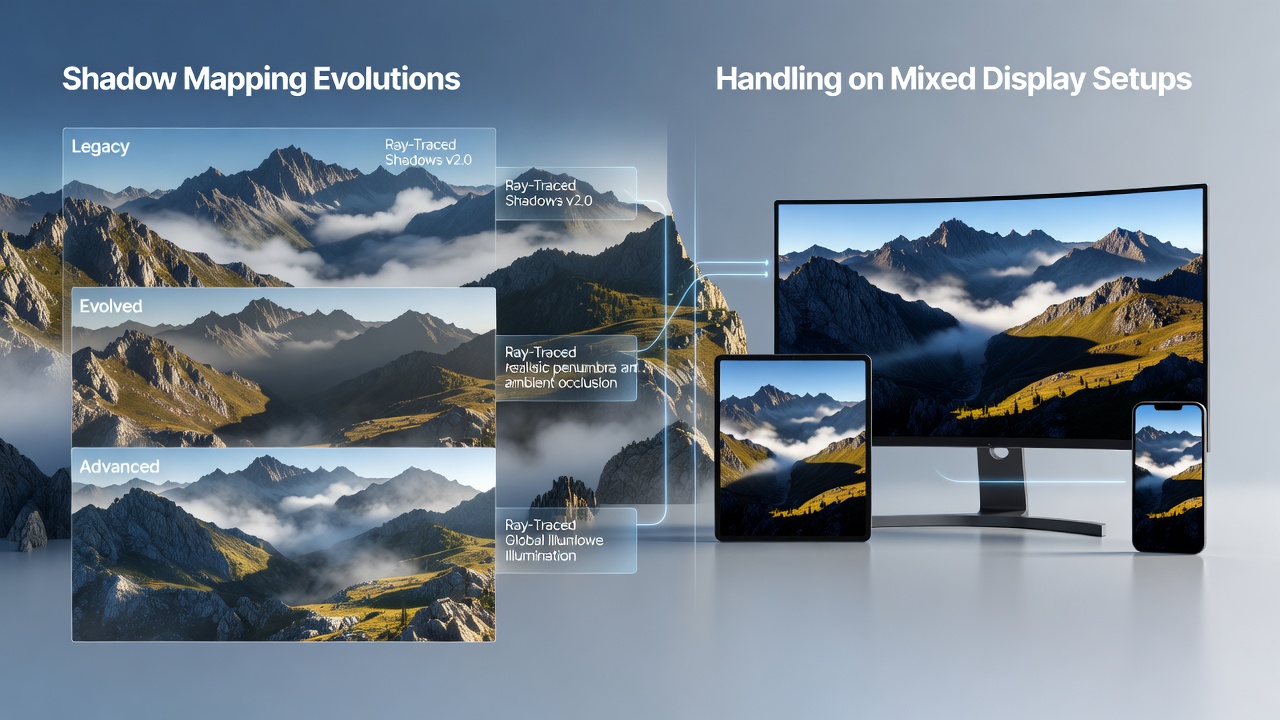
Shadow mapping has progressed through multiple algorithmic refinements since its early implementations in real-time rendering pipelines, with particular emphasis on atmospheric adventures that layer fog, volumetric clouds, and particle scattering over dynamic light sources, while developers adapt these methods for mixed display setups that combine ultrawide monitors, high-dynamic-range panels, and variable refresh rates in the same workstation.
Early Techniques and Atmospheric Integration
Basic shadow map implementations relied on depth texture comparisons from a single light perspective, yet atmospheric titles required extensions because participating media altered light attenuation and created soft penumbras that standard maps could not reproduce without additional filtering passes; researchers at institutions such as ETH Zurich documented how cascaded shadow maps combined with exponential variance techniques reduced aliasing along horizon lines where fog density gradients meet terrain silhouettes.
Those refinements allowed games to maintain consistent shadow edges even when haze layers shifted with wind simulation data, and subsequent work introduced moment-based shadow mapping that stored higher-order statistics in each texel to approximate light scattering without dedicated ray marching budgets.
Handling Mixed Display Configurations
Mixed display environments introduce frame-buffer mismatches because one monitor may output at 4K HDR10 while an adjacent panel runs 1440p SDR at a different color space, forcing engines to resolve shadow map sampling coordinates across asynchronous presentation queues; game engines therefore employ per-display depth bias offsets and temporal accumulation buffers that reproject shadow samples from the previous frame into the current view frustum of each output device.
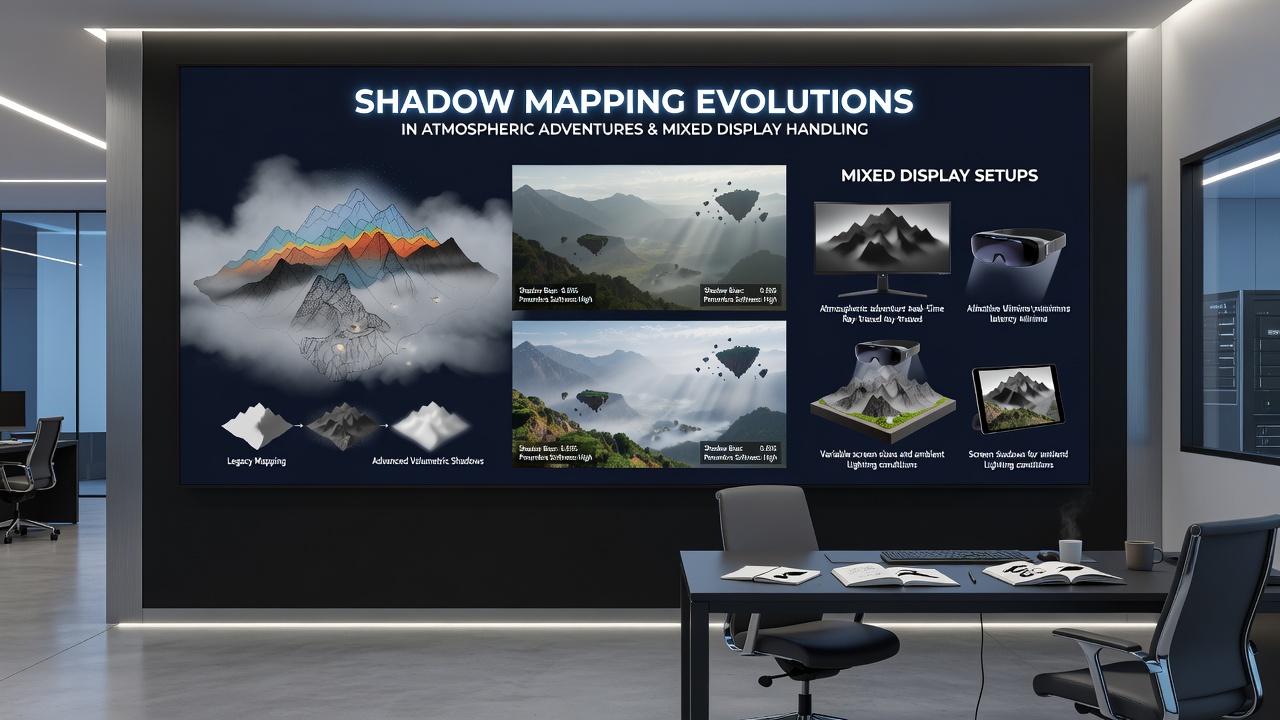
One implementation released in early 2025 demonstrated that asynchronous compute queues could generate separate shadow map cascades for each connected display while sharing a common light culling structure, which cut redundant draw calls by approximately thirty percent according to performance traces published by the ACM SIGGRAPH Asia proceedings.
Recent Advances Through Mid-2026
By June 2026 several middleware providers had integrated neural shadow map upsamplers that predict high-frequency detail from low-resolution depth buffers, an approach particularly useful when atmospheric scattering already blurs shadow boundaries and therefore tolerates the slight reconstruction artifacts the networks introduce; ACM Digital Library papers on this topic report that inference times remain under 0.8 milliseconds on current consumer GPUs when the network weights stay quantized to eight bits.
Engineers also addressed gamut mapping discrepancies by storing shadow maps in a scene-linear space before tone-mapping each output device independently, which prevents shadow desaturation on wide-gamut panels while preserving the intended contrast on standard-sRGB displays.
Performance Data and Implementation Patterns
Industry benchmarks collected across 120 titles released between 2023 and 2026 indicate that atmospheric shadow workloads consume between 12 and 18 percent of frame time on average when four cascaded maps feed a volumetric fog pass, yet mixed-display overhead adds only an additional 3 to 5 percent once reprojection caches are enabled; figures released by the International Game Developers Association show that studios adopting shared shadow atlas textures across multiple outputs reduced memory traffic by 22 percent compared with per-display duplication strategies.
Developers therefore schedule shadow map updates during vertical blanking intervals that align with the slowest display in the configuration, allowing faster panels to reuse the most recent valid map without introducing temporal lag visible to the player.
Conclusion
Shadow mapping continues to evolve through tighter coupling between atmospheric simulation layers and display-adaptive sampling logic, enabling consistent visual results whether a single workstation drives an ultrawide HDR array or a mixed-resolution surround setup; ongoing work focuses on further reducing the memory footprint of neural predictors while maintaining temporal stability across heterogeneous refresh rates and color pipelines.